

Esprit
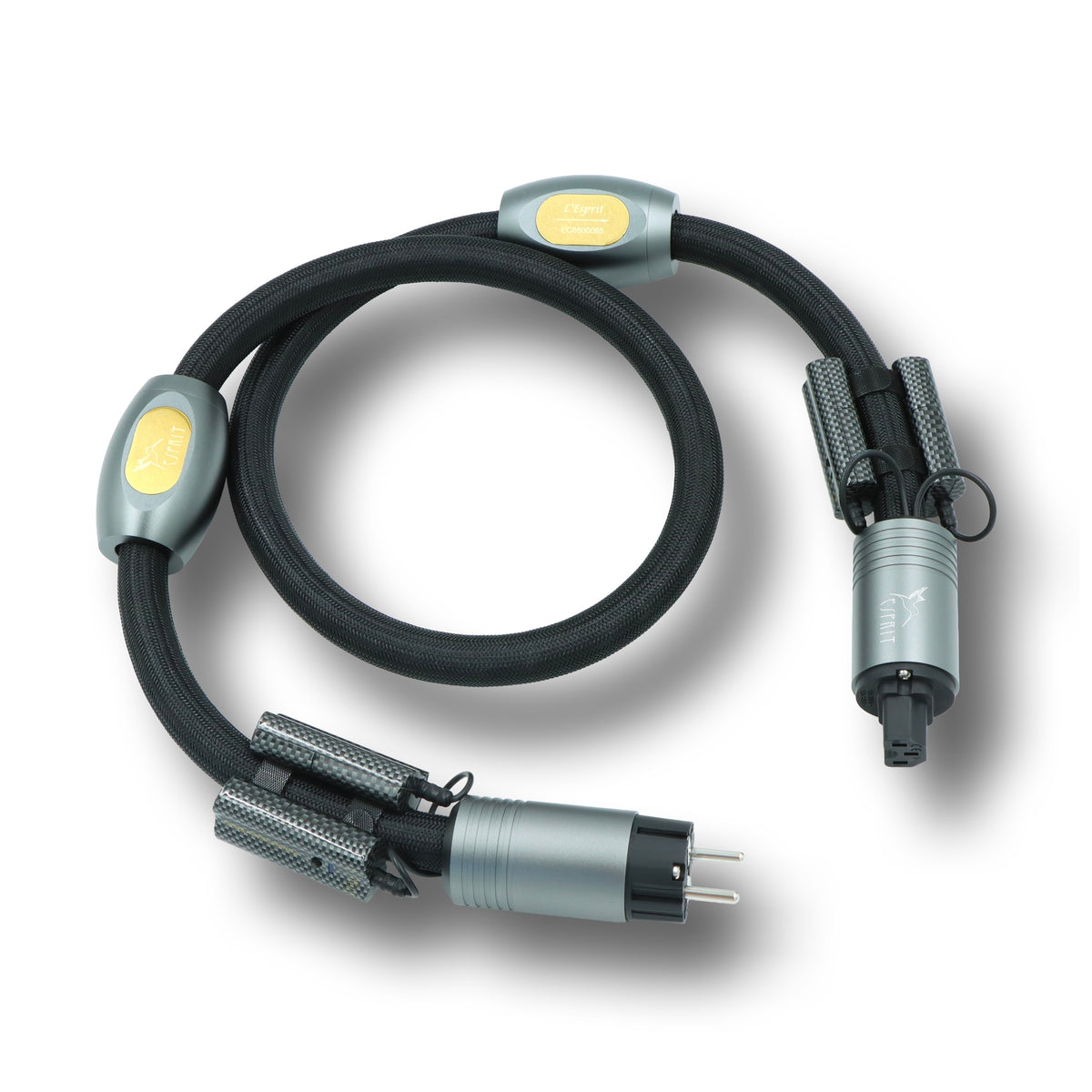
.Esprit AC Power Cables - GenX
.Esprit AC Power Cables - GenX
RRP: ranging from $349 to $28,999
Sold and packaged as Each. Order as each.
An order today ships from France in two weeks.

Esprit High End Audio products are conceived, designed, and hand-assembled in our workshop located in Confolens, Charente. We meticulously select the finest materials and components, chosen for their sonic performance and reliability, which are then precisely integrated by our team.

For over 30 years, Esprit High End Audio has been designing and manufacturing high-end audio cables, driven by a singular imperative: to preserve the integrity of the musical signal. As a culmination of expertise developed and refined over many years, our cables incorporate the finest available conductors, meticulously selected for their electrical properties and sonic neutrality.
The Role of Cable
The fundamental role of a cable is simple: to transmit a signal from point A to point B with as little distortion as possible. A cable cannot add information to the signal reproduced by playback devices, whether they are turntables, streamers, tuners, or tape recorders. On the other hand, it can affect the quality of the sound if its design is not well-executed.
This deterioration can come from many elements: conductors of insufficient quality, unsuitable insulation, connectors made of materials with low conductivity such as brass, or plating chosen for aesthetic reasons or mechanical strength rather than for their electrical properties.
A cable is not intended to correct flaws in a listening room or a device. It must not introduce coloration or compensate for them. Its purpose is to be as transparent as possible, allowing the system’s intrinsic qualities to be fully expressed.
At Esprit, every cable is designed with this goal in mind: to preserve the signal's fidelity and reveal the musical intent without altering it.
The conductivity of materials plays an essential role in the continuity of the signal.
Silver and copper, better conductors at room temperature, allow for a more stable and cleaner transmission than less conductive alloys.
The choice of materials is not intended to modify the signal, but to preserve its integrity.
Beyond the materials, the overall design of the cable is decisive: the cross-section of the conductors, the number of strands, the electrical structure, the type of insulation, the shielding and the quality of the assembly must work in perfect harmony.
At Esprit, particular attention is paid to shielding, which protects the signal from external electromagnetic disturbances, as well as to the polarization of the insulators, which stabilizes the electrical environment of the cable in order to limit dielectric relaxation phenomena.
Conductivity of materials
According to the IACS (International Annealed Copper Standard), the conductivity is referenced on copper (100%), which puts silver around 107%. In order to make the reading more intuitive, we choose here to bring the silver down to 100% and express the other materials accordingly.
Silver: 100% - The best natural conductor. Used for its maximum transmission performance.
Copper: ~97% - Very close to silver, it offers an excellent balance between conductivity, stability and cost.
Gold: ~72% - Less conductive, but highly resistant to oxidation. Used mainly in plating.
Aluminum: ~58% - Correct conductor, often used for shielding rather than carrying the audio signal.
Rhodium, Nickel, etc.: ~40–45% - Used in plating for their resistance to wear and corrosion.
Brass / Bronze: ~25–30% - Economical alloys, but much less efficient in conductivity.
Silver therefore remains the benchmark in terms of conduction, followed very closely by copper.
Other materials are mainly used for their mechanical properties or their stability over time.

Real impact on the signal
In purely electrical terms, the difference in conductivity between copper and silver plays a measurable but moderate role on the level of the signal itself.
On the other hand, the quality of the material strongly influences contact resistance, stability over time, micro-continuity of conduction, and the reduction of micro-arc or oxidation phenomena.
When compared to each other, pure copper or silver connectors generally offer a cleaner, smoother and more accurate reproduction. Less conductive materials such as brass can introduce a feeling of haze or loss of transparency, due to their reduced ability to transmit the signal without interruption. It is not a question of noise level, but of transmission quality and purity of contact.

Number of strands, diameter and cross-section
The choice of the number of strands, their diameter, and the total cross-section of the conductor is a central element in the design of an Esprit cable.
Over the years of listening and development, we have observed that very fine strands make it possible to optimize the reproduction of high frequencies.
Their small diameter promotes better distribution of surface current and more accurate transmission of micro-information.
However, this thinness requires rigorous control of the electrical environment, in particular through the choice of insulators, in order to avoid any excessive emphasis on the high register.
The combination of fine strands with mechanically and electrically stable insulators thus makes it possible to obtain a detailed but perfectly controlled treble, while maintaining a solid foundation in the bass.
The total cross-section also plays a decisive role. A larger cross-section reduces the linear resistance of the cable, thus decreasing the opposition to the passage of the electrical signal.
This decrease in resistance promotes a more stable transmission of current, especially in loudspeaker applications where currents can be significant. When listening, this often results in an increased feeling of background silence, better bass hold and freer dynamics.


The increase in the number of strands not only allows the total cross-section to be fine-tuned but also optimizes the mechanical structure and conduction consistency. By multiplying the thin conductors, it becomes possible to balance precision, fluidity and electrical stability.
At Esprit, each range is precisely dosed between the diameter of the strands, the number of conductors, the type of copper used and whether it is associated with silver. The goal is never to increase the section for its own sake, but to seek the optimal balance between speed, silence, harmonic density and dynamic control.
Flexible and hard insulation
In the design of a cable, the insulation does not only play a mechanical role: it also influences the electrical environment of the conductor and participates in the overall balance of restitution. At Esprit, we use different types of insulators to optimize both signal stability and musical rendering.
PVC, used as a more rigid insulator, provides excellent structural strength. When listening, it is generally associated with a denser reproduction, with a feeling of substance and a marked foundation in the low register. This mechanical stability contributes to a solid and structured listening.
Silicone, which is more flexible, is distinguished by its cushioning properties and its ability to limit mechanical stress. When listening, it promotes a smoother and more natural reproduction, with a feeling of increased openness in the mid-high range and better ventilation of the sound image.
This is why some of our designs deliberately combine hard and soft insulation. This mixture makes it possible to combine the hold and impact provided by a rigid insulation with the fluidity and openness of a flexible insulation, in order to obtain a stable, balanced and extremely natural reproduction.

Shielding
In an audio cable, the conductors carrying the signal can be influenced by many electromagnetic disturbances in our environment.
This interference can come from domestic and audiophile equipment such as Wi-Fi routers, mobile phones, switching power supplies, computers, internet boxes, or even from radio frequency waves and magnetic fields generated by transformers.
However, shielding is not only a protection: it also influences the overall electrical balance of the cable.
Integral shielding, which is very effective against interference, can sometimes modify the perception of dynamics and naturalness of reproduction depending on the system and environment.

Connectors
In an audio cable, the connector is the direct point of contact between the signal and the electronics. It is not just a mechanical accessory: its composition, conductivity and the quality of its plating have a direct influence on the stability of the transmission.
At Esprit, we design our connectors as a natural extension of the conductor itself.
We have developed several generations of RCA connectors to ensure perfect consistency between each cable range and its mechanical interface.
The Esprit XLR connectors, especially on the higher and Gaïa ranges, incorporate pure silver pins. This solution optimizes conductivity along the entire signal path, including in critical connection areas.
Our speaker connectors (bananas and forks) as well as our power connectors are made of pure silver-plated copper, guaranteeing high conductivity and excellent mechanical stability.


Polarization of insulators
An ideal insulator would be a perfectly neutral material, in which no load displacement could occur. In reality, any dielectric has a molecular structure that can become polarized when subjected to an electric field.
When a musical signal passes through a conductor, it generates an electric field that extends into the surrounding dielectric. The molecules of the insulator then become polarized under the effect of this alternating field.
This polarization is not instantaneous: it can cause relaxation and dielectric absorption phenomena, i.e. a slight storage and then a delayed release of energy.
In a conventional architecture, these micro-variations remain extremely small, but they participate in the overall electrical environment of the cable.

At Esprit, we have chosen to go further. From the Eterna range, we apply a DC voltage to insulators in order to permanently stabilize their polarization state.
The objective is not to increase the signal, but to preserve its integrity.
This energization creates a permanent electrostatic field that keeps the dielectric in a stable state, reducing the variations related to the passage of the musical signal.
By limiting relaxation and dielectric absorption, polarization promotes a more consistent, stable and quieter transmission. When listening, this translates into better readability of micro-information, a more structured soundstage and an increased feeling of fluidity.
The polarization of the insulators is therefore a decisive step in the search for neutrality and realism that characterizes Esprit cables.